Showing posts with label Eggs. Show all posts

Saturday, March 26, 2016

Does the Easter Bunny go to Africa?


Special Easter breakfast eggs.
Yesterday I was asked if we were going to have an Easter Egg hunt for our kids?  I spent some time thinking about that, and wondered if we should do it for the big kids living at Emseni or do one for the toddlers too?  Would we use chocolate in the 90F heat or would we have an infestation of ants by hiding candy?  But the question provoked more thought and a bigger discussion. 

Like any family we have to decide which religious holidays we are going to observe, and how we are going to celebrate them with our children.  Which icons will we use and which ones will we not include?  What traditions do we want to start and which ones are left behind?

For example, at Christmas, we have made the collective decision to not introduce Santa Claus or snowmen (we live in Africa) and we don’t decorate with snowflakes, icicles or reindeer.  We do decorate with stars, angels and a manager and we did decide to put up a Christmas tree for the children – a western tradition for sure, but one that we chose to include.

This week we have had to think through Easter and what we want to include for our children.  Thinking about the Easter Egg hunt I was puzzled as to how I would explain to our Caregivers why we would take nice candy and hide it in corners with dust and dirt.  What did the candy egg have to do with the death and resurrection of Jesus?  I could make the link between the eggs and new life, but I wasn’t sure I could explain the candy eggs and the rabbit.

My next step was to sit down with a few of our staff and ask how they were raised and what did most Swazi’s do for Easter.  I was told most of them spent four days in church (!), celebrating the resurrection of Christ.  Every family brings whatever food they can find, and together the women cook for the congregation while they sing songs of praise and worship.  I asked if there was candy involved or did a bunny rabbit make an appearance at any time, and I got a perplexed look. The answer was no, but everyone would enjoy a large plate of cooked maize (like grits) and with some stew on top, hopefully with a few pieces of grizzly meat to enjoy and chew on (the more fat and bone, the better!).

This weekend we will not be introducing the Easter bunny to our children, but we will be sharing the good news about why we celebrate Easter.  We will tell them about how Jesus died on the cross for our sins and then three days later he rose from the dead.  We will make special food (fun eggs that represent new life), have a special church service, play with bubbles, balloons and have lots of water games to stay cool (stay tuned for some cute photos tomorrow!).  

Afternoon snack on Easter
PLEASE do not think I am criticizing anyone who is doing an Easter egg hunt for their own children or handing out chocolate bunnies. I am only telling you what we are doing here, since we do have the opportunity to do it differently than we did for Spencer and Chloe.  

Thank you to all of you who have given this month to help us feed children in our community. If you haven’t spent your entire Easter budget yet, please consider buying the gift of food for the orphaned and vulnerable children of Swaziland.  You can purchase eggs (the perfect protein!), maize, sugar beans or even a goat and we will deliver them to our church partners to feed the children.


To donate in the US click here.

Or if you would like to shop for diapers and wipes for the babies at Project Canaan you can go to our amazon.com Baby Registry by clicking here.

Happy Easter from our family to yours!

Live from Swaziland … Jesus is risen indeed!

Janine

PS - I added a fun "kid" photo since you read all the way to the end :)

A fun weekend for all!

Saturday, January 23, 2016

Did you know a chicken lays an egg every 24-30 hours?


Farming education is a critical part of raising our children at Project Canaan.
Five years ago I met a man named Chad Gregory who is the CEO of the United Egg Producers in the US.  Chad invited me to speak at an International Egg Commission conference in Venice, Italy (I said yes).  While there we met egg farmers from all over the world, including a bunch of fellow Canadians.  Tim Lambert (CEO Egg Farmers of Canada) was one of those men and next thing we knew the Canadian egg farmers were visiting Project Canaan and learning about Swaziland, AIDS, orphans and the crisis that we are facing.

Tim Lambert (CEO Egg Farmers of Canada, Steve Manton (Chairman International Egg Foundation), Chad Gregory (CEO United Egg Producers),  Gene Gregory (Former CEO UEP), Peter Clark (Chairman Egg Farmers of Canada),                  Ian Maxwell (CEO Heart for Africa).   
With each visit they became more and more immersed in learning about the culture, the challenges and hopelessness of so many Swazi people. They were even with me when I got the call about picking up a baby at the Woman’s Prison, and went with me to receive that child.  That child was Baby Shirley, and the Egg Farmers of Canada were the ones holding her in the back seat of my car as we drove her home to Project Canaan, burns and all.   That was the day they truly saw the Project Canaan was a place of hope, and there was hope for the baby girl whose mother tried to kill her by burning her.

They made a commitment to do something, and they are men of their word.

On January 4th, 2016, a flock of 2,500 chickens arrived in to a barn that the Egg Farmers of Canada, in partnership with the International Egg Foundation, built.  They have ordered a second flock of 2,500 chickens, which will arrive in July to the second barn they also built.  That means we will have just under 5,000 eggs, every single day, “with no off switch” as we are told.  Did you know that a chicken lays an egg every 24-30 hours? Now you do.

Did you know that brown chickens lay brown eggs?  And that hens "sing"?
As you likely know, Ian and I know nothing about chickens or eggs, and the egg farmers knew that, so help arrived a few days before the chickens did.  Kurt Siemens, a Canadian egg farmer from Manitoba and Aaron Law, a Canadian egg farmer from New Brunswick, came in January and got the flock in place, feed supply rolling and continued the training that our team had already begun with the largest egg producer in Swaziland and the eggs started to arrive. Kurt was here for 10 days and Aaron stayed on for the whole month!


We currently feed 2,100 children every week through our 30 church partner-feeding programs.  Starting on Monday these children will receive a hard-boiled, PEELED, egg with every meal they get from us.  This will not only help with the issue of malnutrition, but also help providing the perfect protein and assist with the uptake of vaccinations (which is critical to the health of every child).  The egg farmers, thanks to Chad and his friends at UEP, even bought us a new truck so that we can deliver eggs, Manna Pack and maize from Project Canaan to the most remote parts of Swaziland. 

John with Julian Madeley (International Egg Foundation and Worldwide Egg Organization)

Aaron Law, Julian Madeley (CEO World Egg Organization), Dr. Abdul Magdy (Bio-security expert from Lohmann)          Ian and our big kids.
We have also partnered with a local hospital to provide two eggs every day to every child in the pediatric ward.  Many of them suffer from malnutrition and getting a “high protein” diet costs extra money. Now they will not have to pay for that extra protein, it will be free, and they will get well faster.

First delivery of eggs to the hospital CEO and CMO.
God is good. He knows what we need, when we need it and we see His hand of provision over and over again as he sends people, expertise, equipment and funding, in His timing.

In addition to the organizations listed above I would like to also publicly thank the Big Dutchman in South Africa, Sonovo Technolgy Group in Denmark, Lohmann in Uganda and Eagles Nest in Swaziland for donation equipment, expertise, time and money.  This is truly and international project and we are thankful for everyone involved.

I am writing this blog on the roadside just before I cross out of Swaziland in to South Africa.  I am heading back to the US for five days for meetings, a few favorite meals and to see Spencer!  Can’t wait (not excited about the snow storm that I am hearing about).

Live from Swaziland … we live in a constant state of awe (that’s Ian’s favorite quote).

Janine

This peacock came and sat beside me while I finished my blog. Too funny.


Saturday, March 14, 2015

A baby dies every single hour in Swaziland. Can eggs help?


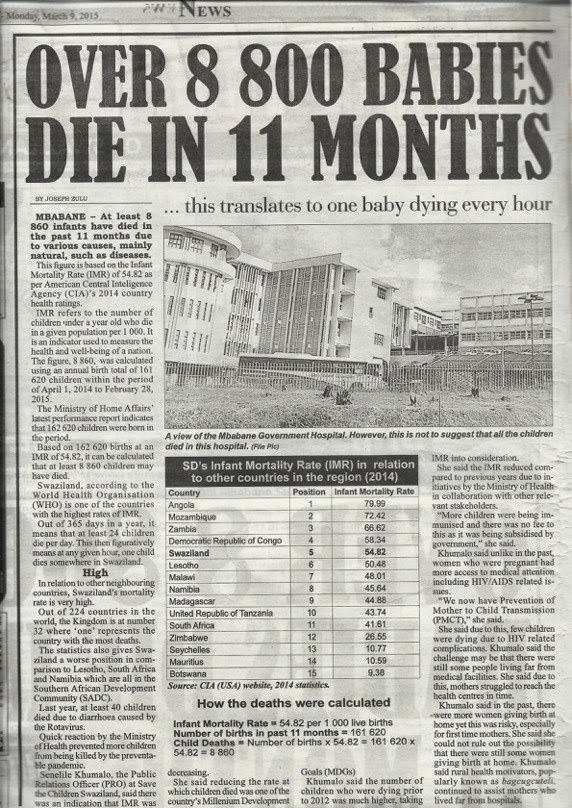
On Monday, March 9th the front page headline of a National newspaper claimed that “Over 8,860 babies die in 11-months”, and for anyone reading that with a smart phone or calculator nearby you can do the math to see that more than 26 babies die every day in Swaziland. That is shocking.

The article went on to explain, “At least 8,860 infants have died in the past 11-months.  This figure is based on the Infant Morality Rate (IMR) of 54.82 as per American Central Intelligence Agency (CIA) 2014 Country Health Ratings.  IMR refers to the number of children under a year old who die in a given population per thousand.  It is an indicator used to measure the health and well being of a nation.”

Swaziland has the 5th highest IMR in the world, only topped by Angola, Mozambique, Zambia and the Democratic Republic of the Congo.

99% of all Childhood Mortality is found in developing nations and it is estimated that 60%-80% of all of those deaths are directly related to low birth weight.*

You can go to the link below and research this yourself, but let me explain this in layman’s terms (or Janine’s terms) how I interpret this based only on my personal observations and experience in Swaziland over the past 10 years.

First, those numbers, based on the CIA, are calculated on a ratio to live births in the country. Therefore, it would be safe to assume that they don’t include babies who die on the side of the river, in pit latrines, who are burned to death by their parents or die of malnutrition at home because their mother was too poor to take them to a hospital.  The number is much higher, I promise you, but undocumented. I am glad to get that off my chest.

Next, while there are other factors that lead to low birth weight, a malnourished mother is at the top of the causes.  I have seen hundreds of women who are in the labor ward at the hospital who hardly look 6-months pregnant, let alone ready to deliver a full term baby.  Women living in the rural communities are living on pap (a porridge made strictly from ground maize/corn, similar to grits, but without the butter or salt).  These young mothers are starving, their babies are starving (and dying) and the other children who are living in the homestead are suffering in the same way, but somehow they dodged becoming a Childhood Mortality statistic.

We are told that 65% of all Swazi’s depend on International Food Aid for one meal a day.  In much of the country the only meal a child will receive in a day is their school lunch, which is provided by the government from Monday to Thursday.  Friday to Monday are very long, hungry days.

Heart for Africa is trying to do our part in helping feed Orphaned and Vulnerable children through our rural church partners.  We currently feed 3,500 children every week and provide 74,000+ hot meals every month.  We distribute Feed My Starving Children “Manna Pack’s” along with ground maize from Project Canaan to the churches every two weeks.  But the churches are being stretched by more and more hungry children, and so are we.

Here is where this story gets hopeful.  Ian and I will be flying to Canada on March 22nd at the invitation of the Egg Farmers of Canada (EFC - www.eggfarmers.ca).  We will be speaking at their Annual General Meeting and sharing with the Canadian egg farmers, and the Canadian population through media about the plight of the children of Swaziland (both born and unborn).  The EFC has signed a partnership agreement with Heart for Africa to fund, build, support and provide training for an Egg Farm on Project Canaan that will provide thousands of hardboiled eggs each and every day that we will then distribute to the children in our rural feeding projects.

“Once complete, the Egg Farm will provide fresh eggs for all the children living on the Project Canaan Farm, and also help thousands of people in the community by providing a high quality, locally produced protein, that’s essential for human growth and development.”  Tim Lambert, CEO Egg Farmers of Canada.

Providing eggs isn’t going to solve the Infant Mortality Rate of Swaziland overnight, but over time, eggs can play a significant role in increasing the County Health Rating and I do believe that they will save many lives and increase the health of thousands of children. In the meantime, we will do our part by saving the babies that we can, and providing for them with the support of our friends.

Live from Swaziland … I want to Get Crackin’ (and make breakfast).

Janine

Saturday, June 14, 2014

880,000 hard boiled eggs a year?

Fred, Peter, Kurt, Brad, George and Tim.
Today we said goodbye to a team from the Egg Farmers of Canada (EFC) including their Chairman, Peter Clarke.  It’s been an egg-citing week and today is a good day to share it on this blog.  It’s a jaw-dropper!

We met Peter and his team two years ago when I was invited to speak at the International Egg Commission (IEC) Conference in Venice, Italy.   Since that time we have had visits from the Chairman of the IEC, the Chairman of the American Egg Board (AEB) and other important members of their respective teams.    After many conversations, emails, brainstorming sessions and site visits we now have a plan.

You may not believe this one, but I assure you it’s true.

These multi-generational Egg Farmers want to help the orphaned and vulnerable children of Swaziland by providing one of the most nutritious foods on the planet – hard boiled eggs!  Eggs are one of the few foods considered to be a complete protein, because they contain all nine essential amino acids. Amino acids are considered the "building blocks for the body" because they help form protein*.  The children of Swaziland need these building blocks!

Showing the rural children how to peel and eat a hard boiled egg.
The EFC and IEF have chosen Project Canaan in Swaziland to be the Pilot Project for finding ways to help children around the world who are in need of protein and proper nutrition.

The plan is to build an egg production facility that will produce in excess of 18,500 eggs per week, which will then be hard boiled and distributed to the children who are being fed through our rural church partners. This will provide an animal protein every day to each child we currently feed, in addition to the important vegetable protein that the children currently get through the Feed My Starving Children Manna Pack.  The fundraising, expertise and training will come through the EFC, and in addition the IEF is providing the services of Dr. Vincent Guyonnet**, who is the Scientific Advisor to the IEC, for Project Management and expertise.  


Heart for Africa currently provides 74,000 hot meals each and every month to orphans and vulnerable children in the most rural areas. That is 880,000 meals per year.  If the need continues to grow as it has in the past few years we anticipate that number growing to 2.6 million meals by the year 2020.  Our hope and plan is to grow the egg production to meet that need alongside our Feed My Starving Children partnership.

In 12-18 months from now we will have Project Canaan Eggs, in a big way. Un-boiled eggs will be provided for the children living at Project Canaan, which will in turn reduce our monthly grocery spending.  We will be able to train and employ people to work at the poultry facility and we will start distribution to the children at our church partners. 


This will not be a commercial egg production facility – these eggs are to be put into children’s hands and mouths in the same way we would put TOMS Shoes directly on children’s feet … all thanks to a group of kind hearted, caring, passionate, enthusiastic men who believe that this is not just about Corporate Social Responsibility, it is simply the right thing to do.

CEO of EFC, Tim Lambert, and Baby Timothy.
This was an egg-cellent week and we are more than egg-cited about this new partnership, and more importantly, our new friends.

Live from Swaziland … it’s time Get Cracking!

Janine
Of course they also helped with little road repair.
* www.eggs.ca

** IEC Scientific Advisor - Dr Vincent Guyonnet


Dr Vincent Guyonnet, DVM, Ph.D, Dipl. ACPV, was appointed as IEC Scientific Advisor in January 2010. Vincent is responsible for helping IEC deliver on its commitment to science based positions and guidelines as well as developing its relationships with international and intergovernmental organisations.

Vincent is a native of France, he obtained the degree of Doctor in Veterinary Medicine in 1987 from the National Veterinary School of Lyon, France and a Ph.D degree from The University of Georgia, Athens, GA, USA in 1991.  He was accepted as a diplomate of the American College of Poultry Veterinarians (US board certification) in 1994.

Vincent joined Burnbrae Farms Limited in June 2005 as Vice President – Research & International Business Development, and in 2007, received additional responsibilities for Quality Assurance.
Prior to joining Burnbrae Farms Ltd, Vincent worked for Pfizer Inc. from 1991 to 2005 in the Animal Health Group.   Vincent assumed a number of positions of increasing responsibilities in research, technical services, regulatory affairs and marketing (Pfizer World Headquarters, NY, NY, USA) and was general manager of Pfizer Australia – Animal Health Group (Sydney, Australia).

He has authored 10 peer-reviewed papers, given 25 communications at US and international scientific meetings and congresses and has been a guest lecturer at universities in Australia, Egypt, France, Malaysia and Thailand.